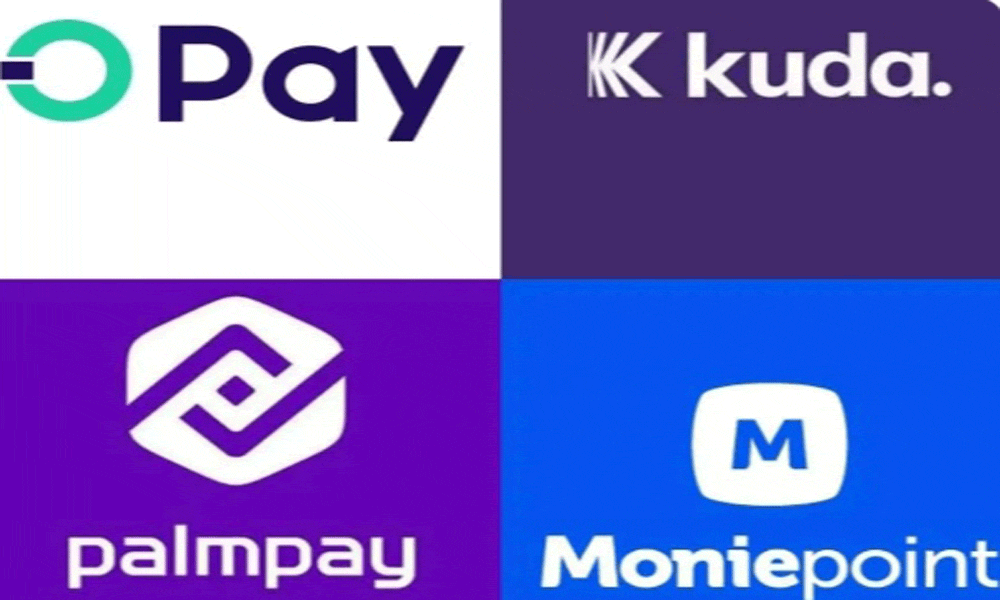
The Central Bank of Nigeria (CBN) has upgraded the operating licences of several leading fintechs and microfinance banks, including Opay, Moniepoint, and Kuda Bank, granting them full national status.
The move formally recognises the nationwide reach of these digital-first institutions, many of which had already scaled across Nigeria despite holding licences that were originally limited by geography or operational tier.
Why the CBN Made the Move
The announcement was made by Yemi Solaja, Director of the Other Financial Institutions Supervision Department at the CBN, during a banking conference in Lagos.
According to Solaja, the regulator reviewed the licences of several fintechs and microfinance banks after identifying a growing mismatch between their legal approvals and the reality of their operations.
“Some institutions were operating nationwide with licences that did not reflect their true footprint,” he said, adding that the upgrade was necessary to align regulation with scale.
For the CBN, the shift marks a broader policy push: allowing fintechs to grow—but ensuring that regulation, capital, and supervision grow with them.
1. From Limited to National Reach
Before now, most fintechs and microfinance banks operated under unit, state, or tiered licences, which restricted where they could legally operate. Despite this, platforms such as Opay, Moniepoint, Kuda, and PalmPay expanded nationally through mobile apps and large agent networks.
By granting national licences, the CBN has effectively regularised what had already become market reality—bringing these institutions fully under national regulatory supervision.
2. Clear Accountability for Customers
According to the CBN, national licensing improves consumer protection, especially in a digital banking environment.
When issues arise—failed transfers, frozen accounts, fraud disputes—customers need clarity on where complaints are handled and who is accountable, even when services are delivered without physical branches.
Licence Tiers Explained
Nigeria’s microfinance and digital banking framework traditionally includes three main licence categories:
🔹 Unit Microfinance Bank
Operates from a single location
Serves a small local community
Lowest capital requirement
Limited customer reach
🔹 State Microfinance Bank
Operates within one state
May open multiple branches in that state
Moderate capital requirement
🔹 National Microfinance Bank
Operates across all states in Nigeria
Supports large digital platforms and agent networks
Subject to the highest regulatory and capital standards
Fintechs like Opay, Moniepoint, and Kuda now fall firmly into this third category.
Capital Requirements: What National Status Demands
With national licences come significantly higher capital obligations.
Under CBN regulations:
Unit MFBs require minimum capital in the hundreds of millions of naira
State MFBs require capital running into the billions
National MFBs must maintain capital levels of ₦5 billion or more
These higher thresholds are designed to ensure that nationally operating institutions can:
Absorb operational and credit risks
Protect customer deposits
Maintain system stability at scale
The CBN has made it clear that growth without adequate capital backing is no longer acceptable.
Why This Matters for Financial Inclusion
Fintechs and agent banking networks already play a central role in moving money across Nigeria, especially in rural and underserved communities.
Industry data shows that Opay alone controls over 563,000 POS agents, out of Nigeria’s estimated 1.5 million agent network. Moniepoint and PalmPay also command large shares of agent-led transactions.
The CBN views these platforms as critical to expanding access to financial services—but only if they operate within strong, well-capitalised regulatory frameworks.
Higher Expectations for Fintechs
National licensing raises expectations across the board. Fintechs with upgraded licences are now expected to:
Strengthen customer support and dispute resolution
Improve KYC and anti-money laundering controls
Maintain physical touchpoints in key locations
Invest in risk management and governance systems
Failure to meet these standards could attract sanctions, licence downgrades, or financial penalties.
A Maturing Fintech Market
The licence upgrades signal a shift in Nigeria’s fintech policy—from rapid expansion to regulated maturity.
Rather than curbing innovation, the CBN’s approach aims to ensure that fintech growth is sustainable, accountable, and aligned with the stability of the broader financial system.
For Nigeria’s biggest digital banks, national status is both recognition—and responsibility.